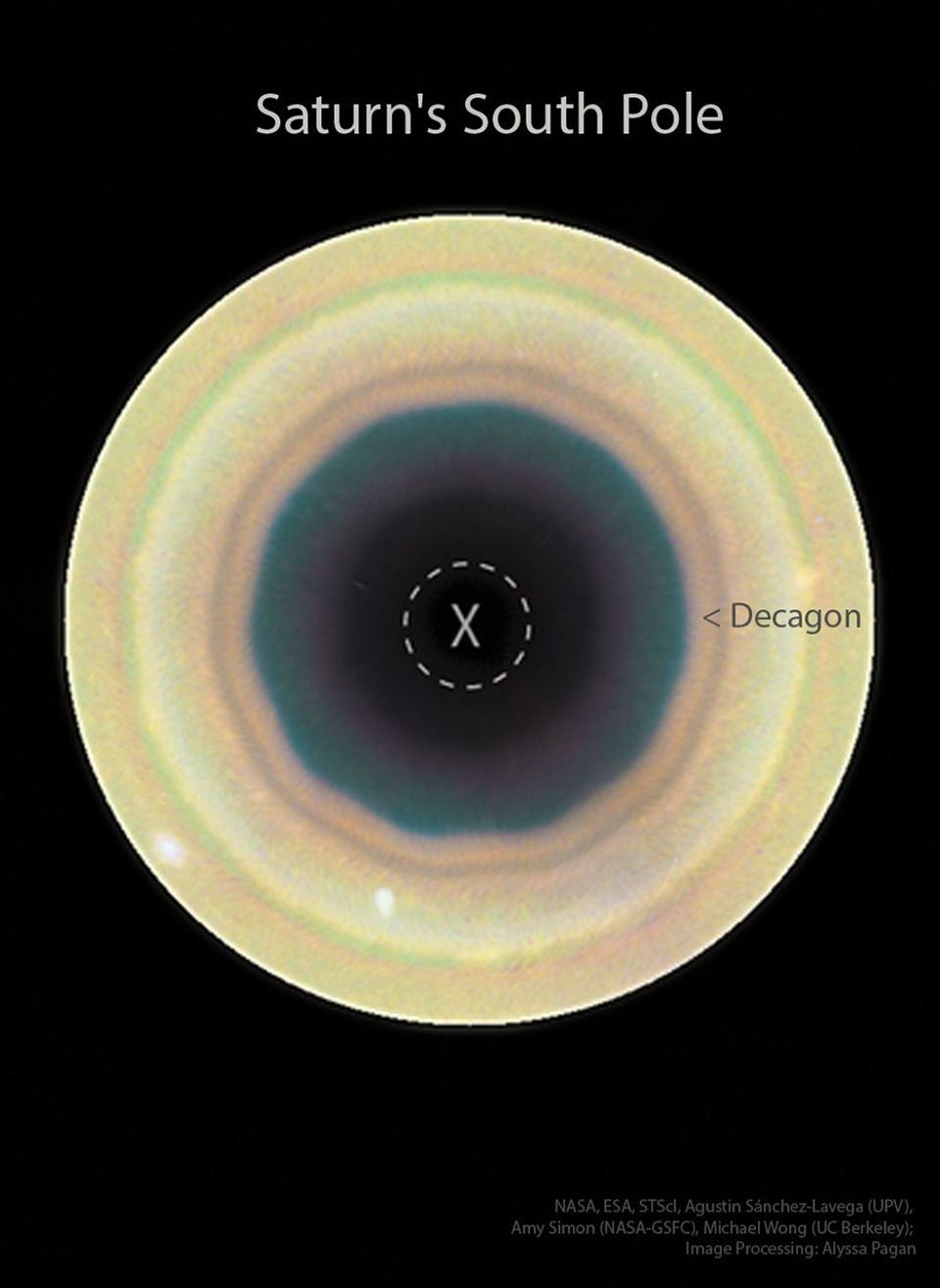
Look closely at the geometric precision of Saturn's southern hemisphere, and you will find a celestial anomaly that defies the chaotic turbulence expected in planetary atmospheres. Instead of a random swirl of storms or a uniform band of winds, the Hubble Space Telescope has revealed a striking decagon—a ten-sided polygon—hugging the planet's south pole. It is a shape so sharp and regular that it looks less like a natural meteorological phenomenon and more like a blueprint drawn by an alien architect.
This geometric marvel is not a solid structure but a pressure belt where the winds behave with an almost mathematical rigidity. At this latitude, the jet stream does not simply flow; it organizes itself into a stable, counter-clockwise circulation. The sheer improbability of nature generating such a specific symmetry without human intervention is what captivates astronomers. It suggests that under the right conditions of temperature, rotation, and atmospheric density, fluids can spontaneously organize into complex, high-order symmetries, challenging our intuition about how gases should behave in a turbulent system.
Comments
Post a Comment