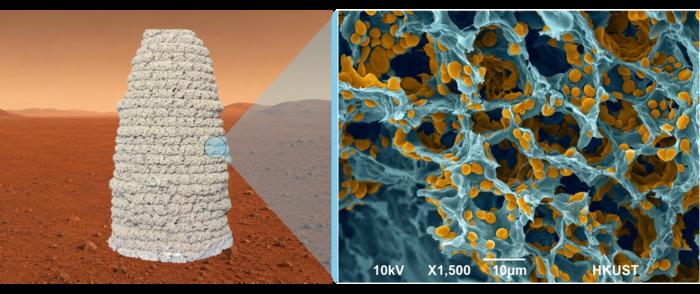
In the cold, dusty silence of the Red Planet, the dream of a permanent human outpost often hits a hard wall of economics. The current reality of space exploration is defined by the tyranny of the rocket: every kilogram of building material launched from Earth costs tens of thousands of dollars, a price tag that makes constructing even a simple pressurized habitat a logistical nightmare. To survive on Mars, we cannot simply bring our homes with us; we must learn to grow them from the very regolith beneath our boots.
This fundamental shift from shipping steel to synthesizing it from local resources is where biology takes the lead over heavy industry. A groundbreaking study led by Ning Liu at the Hong Kong University of Science and Technology, recently published in the journal Chem Circularity, proposes a method that turns this impossible task into a biological inevitability. Instead of relying on massive excavators to crush rocks for construction aggregate, the team has engineered a strain of yeast capable of transforming Martian soil directly into structural concrete.
Comments
Post a Comment