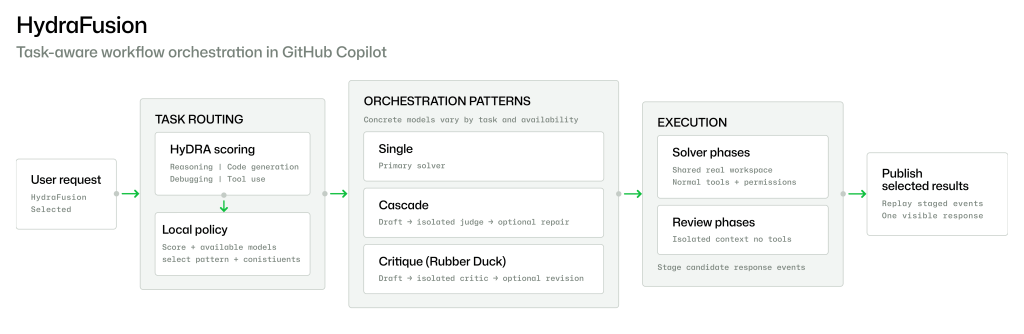
In the high-stakes arena of software development, the search for perfection is often a journey of diminishing returns. We have spent years chasing the elusive "frontier" of code generation, training models until they are indistinguishable from human experts, only to find that the cost of deploying these monolithic giants makes them impractical for most teams. The prevailing assumption was that to get better code, you needed a bigger, smarter, more expensive model. But what if the answer wasn't to build a larger beast, but to orchestrate a smarter choir? This is the core insight behind Project HydraFusion, a new approach that challenges the status quo of single-model dominance.
The problem with relying on a single flagship model, like the Opus 5 baseline, is not necessarily that it produces bad code, but that it is inefficient. It applies a sledgehammer to every nail, expending massive computational resources on tasks that could be solved with a precise, lightweight tool. In controlled offline evaluations, the research team at GitHub discovered that by shifting from a monolithic strategy to a multi-model orchestration framework, they could match or even exceed the quality of the best standalone models while significantly reducing the estimated workflow cost. It is a revelation that quality does not require scale; it requires selection.
Comments
Post a Comment