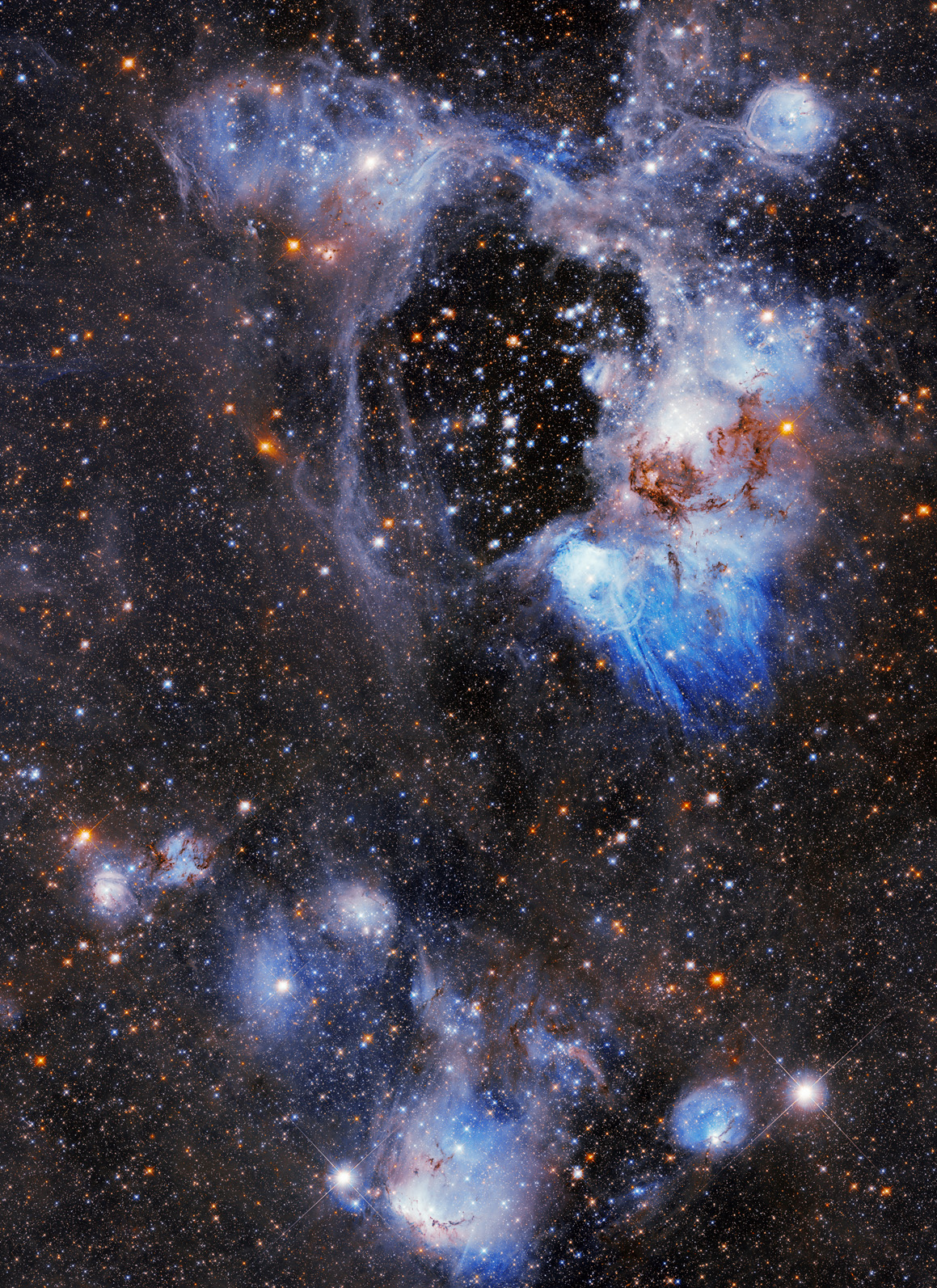
In the vast, velvet expanse of the cosmos, where silence is the only constant, there exists a region that defies the quietude with a roar of stellar violence. Nestled within the Large Magellanic Cloud, a satellite galaxy clinging to the edge of our own Milky Way's gravitational embrace, lies N44. It is not merely a nebula in the traditional sense of a gentle cloud of gas; it is a chaotic, high-energy laboratory where the laws of physics are pushed to their breaking points by the sheer weight of existence. Here, glowing hydrogen gas and dark lanes of dust weave a complex tapestry, masking and revealing massive stars that burn with a ferocity invisible from Earth.
At the heart of this celestial drama lies a feature so striking it demands a second look: a dark, starry gap known as a superbubble. Unlike the empty voids often depicted in science fiction, this gap is a testament to active creation. It is not a place where nothing exists, but rather a region where the density of stars is so profound that they outshine the surrounding gas, creating a silhouette against the backdrop of the universe. Visible in the upper central region of Hubble Space Telescope imagery, this bubble appears as a hollowed-out sphere, a scar left behind by the relentless winds of the most massive stars ever discovered.
Comments
Post a Comment