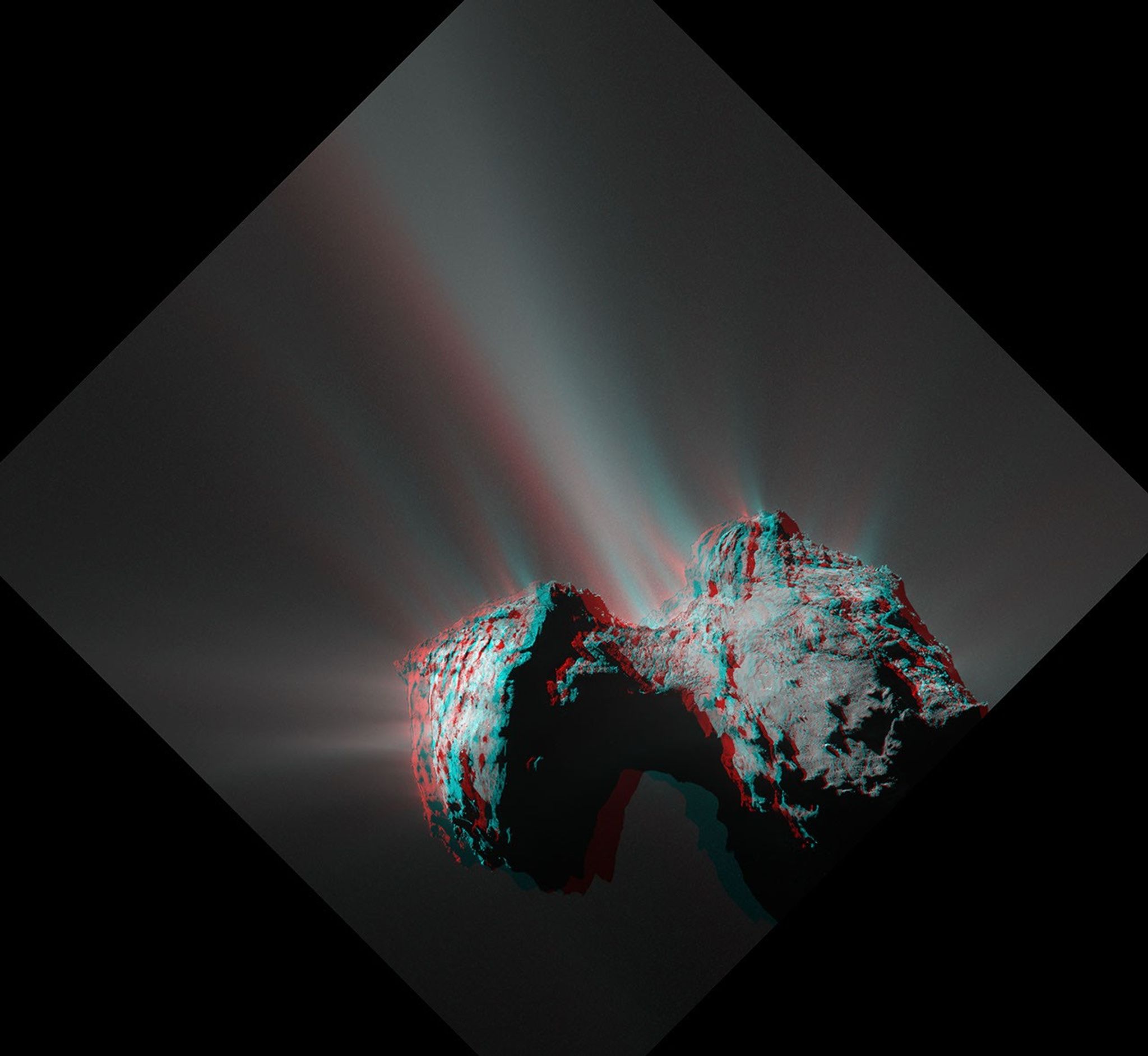
There is a profound sense of scale that only becomes apparent when we stop looking at a single point of light and begin to appreciate the complex, three-dimensional architecture of the cosmos. The image presented today captures Comet 67P/Churyumov–Gerasimenko not merely as a fuzzy blob in the sky, but as a rugged, alien landscape sculpted by eons of solar wind and gravitational tides. It is a reminder that the universe is not a static painting, but a dynamic theater of constant change, where every grain of dust and every frozen patch of nitrogen tells a story of motion and time that predates human existence by billions of years.
The nucleus of this comet, named after the two astronomers who discovered it in 1969, possesses a shape that defies simple geometric classification. It resembles a rubber ducky, a lumpy, bilobed structure formed when two smaller bodies merged in the deep past. This oddity is not merely a curiosity; it is a fossil record of the early solar system's chaotic assembly. By studying its topography through the eyes of the Rosetta mission, we gain access to a history book written in ice and rock, revealing how the building blocks of our own planetary system collided and coalesced in the darkness of space long before Earth formed.
Comments
Post a Comment